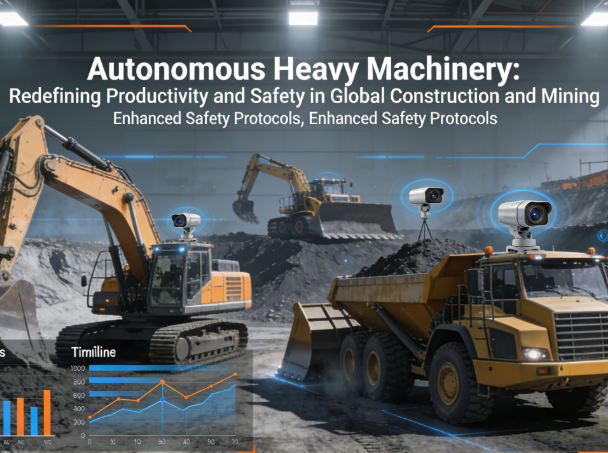
In the pursuit of operational excellence and enhanced worksite safety, autonomous heavy machinery has emerged as a transformative force, reshaping the landscape of construction, mining, and quarrying industries. As of 2026, the global market for autonomous heavy equipment is projected to exceed $45 billion, with a compound annual growth rate (CAGR) of over 28% from 2023 to 2028. This growth is driven by the industry's urgent need to address labor shortages, improve safety records, and boost productivity in the face of increasingly complex projects.
Autonomous operations have consistently demonstrated their ability to deliver superior results compared to traditional manned operations. For instance, Caterpillar's autonomous Cat 797F haul trucks, deployed in large-scale mining operations, have achieved a 100% safety record over millions of operating hours, eliminating human error-related incidents. Similarly, Komatsu's Autonomous Haulage System (AHS) has hauled over 11 billion tons of material globally, increasing productivity by an average of 15-20% by enabling 24/7 operations and optimizing route planning. These technologies are no longer experimental; they are proven solutions that deliver tangible ROI.
The reliability of autonomous heavy machinery is built on a robust technological stack:
Multi-Sensor Fusion: Modern autonomous vehicles are equipped with a suite of LiDAR, radar, cameras, and GPS. This multi-sensor approach ensures 360-degree situational awareness, even in low-light, dusty, or rainy conditions, which are common in mining and construction environments.
Edge AI Processing: Leveraging platforms like NVIDIA's Jetson Thor, these machines process vast amounts of data on-board, enabling real-time decision-making without relying on a distant cloud server. This is critical for maintaining responsiveness and safety in remote locations with limited connectivity.
V2X Communication: Vehicle-to-Everything (V2X) technology allows autonomous machines to communicate with each other and with central control systems. This "platooning" capability optimizes traffic flow on site, reduces idle time, and prevents collisions, creating a synchronized and efficient worksite ecosystem.
While mining was the early adopter, autonomy is rapidly expanding into new sectors:
Construction: Companies like Volvo Construction Equipment are piloting autonomous wheel loaders and excavators on urban construction sites. These machines can perform repetitive tasks like material handling and site grading with millimeter-level precision, significantly reducing the time and cost of large infrastructure projects.
Quarrying: As highlighted in Caterpillar's expansion into quarry applications, autonomous systems are proving their adaptability. They excel in the consistent, high-volume material movement required in quarries, where they can operate continuously without fatigue.
Agriculture: In the agricultural sector, autonomous tractors and harvesters are optimizing planting and harvesting operations, reducing fuel consumption, and ensuring more uniform crop yields.
The widespread adoption of autonomous heavy machinery is not without its challenges:
Initial Investment Costs: The upfront cost of autonomous equipment is still higher than traditional models. However, the total cost of ownership (TCO) is rapidly becoming more favorable due to reduced labor, fuel, and maintenance costs.
Regulatory Frameworks: Governments are playing catch-up in developing clear regulations for the operation of autonomous heavy vehicles on public and private worksites. Regions like Europe and North America are leading the way in establishing safety standards.
Workforce Transition: The industry is shifting from a model that requires skilled operators to one that needs technicians and data analysts. Companies are investing in reskilling programs to ensure their workforce can manage and maintain these advanced systems.
As we look to 2030, the vision for the heavy industry is clear: a worksite where humans and autonomous machines collaborate seamlessly. Humans will focus on high-level decision-making, supervision, and complex problem-solving, while autonomous machines handle the repetitive, dangerous, and physically demanding tasks. This transition is not about replacing human workers, but about empowering them to work smarter and safer, building a more sustainable and productive future for the global heavy industry.